
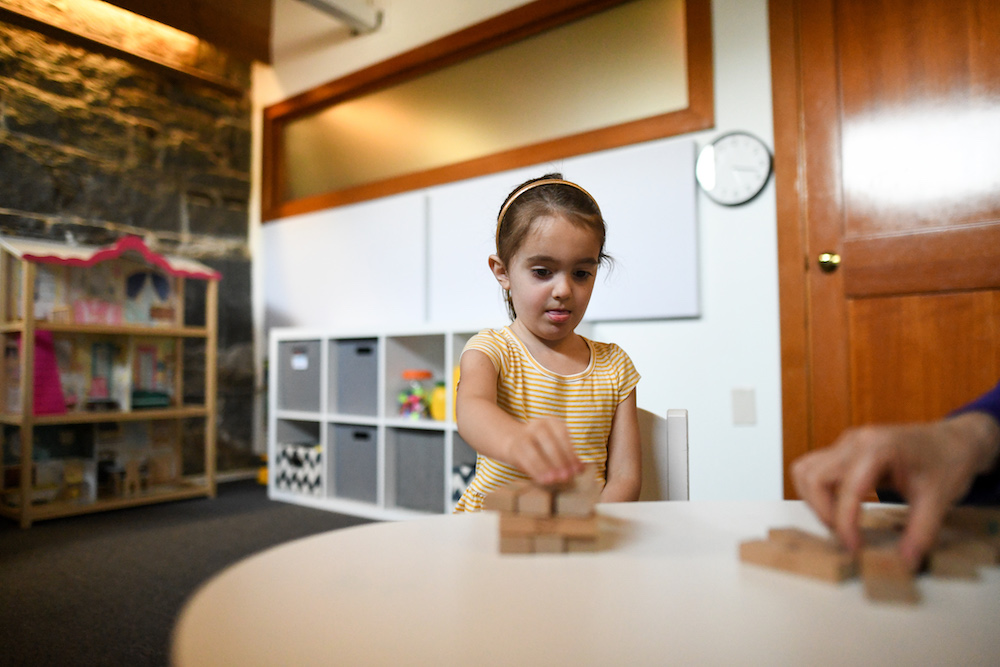
When you hear occupational therapy (OT), you may think of adult rehab or career support, not a service for kids. But for children, OT is all about helping them do the things that make up their daily lives. In this blog, we’re breaking down what pediatric occupational therapy really is, what it looks like here at Puzzle Pieces, and how it can support your child’s growth in meaningful, everyday ways.
What is pediatric occupational therapy?
Pediatric occupational therapy supports children in developing the skills they need to participate meaningfully in everyday life, like playing, learning, self-care, regulating their bodies and emotions, and connecting with others.
Occupational therapists work on activities of daily living like getting dressed, brushing hair and teeth, using the toilet, etc. They also aid in tolerating transitions, managing big feelings, focusing in school, engaging in play, or feeling comfortable in their body. Overall, OT is not about fixing a child. It’s about understanding how they experience the world and supporting them developmentally.
How would you explain occupational therapy to someone hearing about it for the first time?
When parents hear “occupational therapy” for the first time, it can sound confusing or even misleading, so we often explain it this way:
When we think about the word “occupation,” let’s think about how you occupy your time in a day. What is meaningful to you? What gives you purpose? Children have two main occupations, with the first and most important being play, and the second being a student. Occupational therapy helps children do the things they need and want to do with more ease, independence, confidence, and regulation.
How is occupational therapy at Puzzle Pieces different from more traditional or clinic-based models?
At Puzzle Pieces, occupational therapy is relationship-based, developmental, and neurodiversity-affirming. Rather than focusing solely on isolated skills or compliance-based goals, we look at the whole child. This includes:
- How they regulate their body and emotions
- How they engage with people and their environment
- What supports their sense of safety, agency, and connection
Our OTs work from a developmental lens, often informed by DIR Floortime, meaning we meet children where they are and build skills through play, relationships, and meaningful experiences, not drills or pressure. When we say “meeting children where they are,” we mean it both philosophically and literally. While therapy can take place in our clinic, our occupational therapists also work in schools, daycares, homes, and in the community, supporting children in their natural environments. This allows us to help skills generalize into real life, where challenges actually happen, and growth matters most.
What does a typical OT session look like at Puzzle Pieces?
We know that no two children experience the world the same way, and therapy shouldn’t be one-size-fits-all. Our therapists take time to understand each child’s unique sensory profile, developmental strengths, challenges, interests, and nervous system needs. We ask questions like:
- What helps this child feel regulated and safe?
- What overwhelms them?
- How do they communicate stress or needs?
- What motivates and engages them?
- What is the just-right challenge to help build new skills?
From there, therapy is thoughtfully adapted moment-to-moment. The goal isn’t to push a child through discomfort, but to support growth at a pace that feels achievable and respectful.
A typical OT session at Puzzle Pieces often looks like play! Underneath this play is thoughtful, intentional clinical work. Sessions may include:
- Swinging, climbing, or deep pressure activities to support regulation
- Play-based challenges that build planning, flexibility, and frustration tolerance
- Fine motor or visual-motor activities woven naturally into games or play themes
- Support with transitions, body awareness, and emotional regulation
Most importantly, sessions are guided by connection and attunement. Our therapists continually observe, adjust, and respond to the child’s cues to help them feel safe, engaged, and successful.
What kinds of skills do children work on in OT?
Children work on a wide range of skills, depending on their needs, including sensory processing and regulation, attention and executive function (planning, task initiation, time management, flexibility, follow-through), fine motor and visual-motor skills, body awareness and coordination, and emotional regulation and coping strategies. All of these skills directly impact daily life in how a child functions at home, participates in school, plays with peers, and navigates challenges with more confidence.
How can parents support their child’s OT goals at home between sessions?
Parents are a vital part of the therapeutic process. We prioritize collaboration and parent education so strategies feel realistic, doable, and aligned with your family’s daily life, rather than like another thing on your to-do list. Between sessions, support from parents may look like:
- Creating predictable routines that support regulation
- Using sensory strategies recommended by your child’s OT
- Adjusting expectations based on developmental capacity
- Supporting regulation before problem-solving or teaching
- Following a home exercise program
What kinds of changes or progress do you often see in children after participating in occupational therapy?
Progress in occupational therapy is often about how a child feels and functions. Families commonly notice improved regulation and emotional flexibility, increased confidence and independence, fewer daily power struggles, better participation in school, play, and routines, and overall, a child who feels more comfortable in their body and environment. These changes are not immediate and build over time, but they can be incredibly meaningful not just for the child, but for the whole family.
If you’re interested in learning more about how occupational therapy could benefit your child and your family, contact Puzzle Pieces today.