
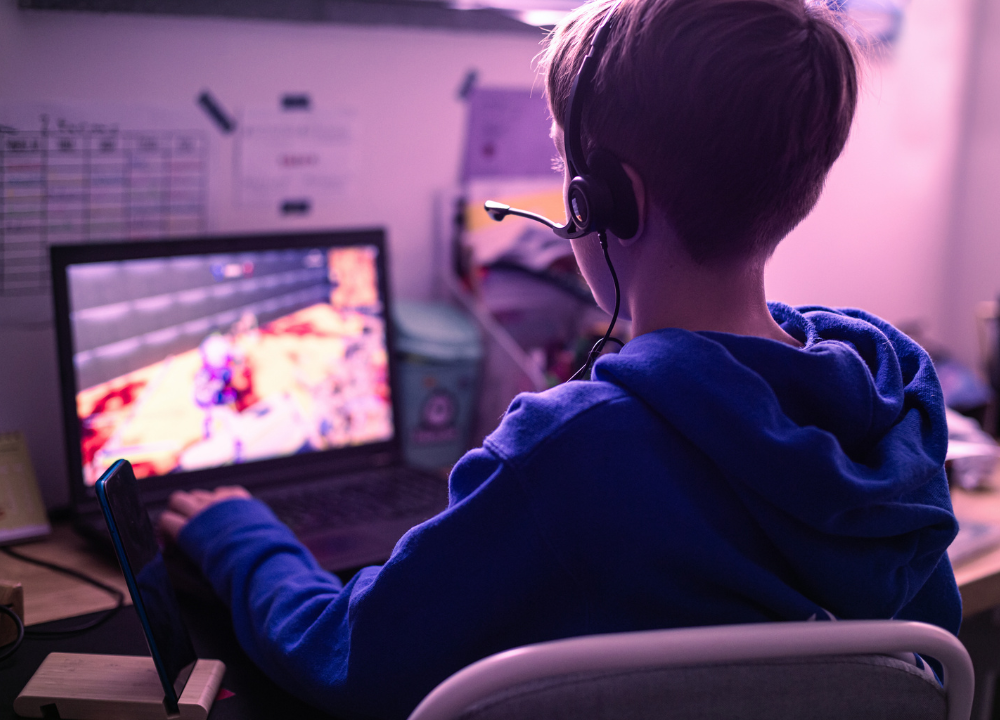
Gaming is a huge part of childhood today. For many kids, it’s where they connect, explore their identity, and feel capable. For many parents, it can also become one of the biggest daily stress points. If turning the game off leads to meltdowns, bedtime battles, or your child “disappearing” into a screen, you are not alone.
Brittany Kyriakides, LCSW, and Certified Problematic Gaming Specialist, recently led a free workshop at Puzzle Pieces, walking parents through a compassionate, neurodiversity-affirming framework for understanding gaming and setting supportive limits. This was not an anti-gaming talk, but rather a seminar about learning how to understand what gaming is doing for your child, how to keep it in the role of play, and how to make sure gaming is not the only place your child can cope.
Why Gaming Matters
At Puzzle Pieces, we often say play is the language of children. Through play, kids communicate, try on roles, build skills, and experience mastery. In today’s world, video games are one of the primary play spaces. Still, because so much of what’s happening, like problem solving, emotion, identity exploration, and social connection, is happening internally, this can be hard to recognize from the outside.
Why Games Feel So Hard to Turn Off
Before talking about limits, we encourage you to understand why games are so engaging in the first place. Unlike a playground, many games are intentionally designed to keep players engaged as long as possible. They often do this by offering:
- Clear goals and a “next step” (predictable structure can feel regulating)
- Immediate feedback (you know right away if you did it “right”)
- Just-right challenge (not too hard, not too easy)
- A strong sense of competence (allowing many kids to feel most successful in-game)
- Identity and self-expression (avatars, skins, roles like healer/tank)
- Social belonging (friends, teams, shared status, Discord/chat)
For kids who feel overwhelmed, uncertain, or misunderstood in other settings, gaming can become a reliable place where the world makes sense.
What’s Happening in the Brain
When kids are gaming, the brain’s reward pathways can light up intensely, while the parts responsible for executive functioning (flexible thinking, stopping, shifting tasks, noticing hunger/thirst) may be less engaged. This is why some kids will play past hunger, ignore bathroom cues, or struggle to disengage even when they want to. It’s not laziness or a character flaw. It is a brain doing what brains do, especially in adolescence, when the brain is wired to prioritize reward, novelty, and identity exploration.
Not All Games Are the Same
“Gaming” covers a wide range of experiences. A child playing a creative, open-ended game is getting something different than a child playing a fast-paced competitive game. It can be helpful to get curious about what kind of games your child gravitates toward:
- Open-ended/creative (Minecraft, many Roblox* experiences)
- Competitive/high-intensity (Fortnite, Overwatch)
- Social/cooperative (Among Us and similar social games)
- Solitary/story-based (single-player games)
*It is important to note that Roblox is a platform, not a single game. Children can access many different game types within Roblox, which is why it is especially helpful to understand what your child is playing there.
When should parents be concerned?
Gaming becomes a concern when it stops feeling like play and starts feeling like the only place a child can succeed or relax. Don’t worry about counting hours as much as recognizing patterns and impact. Red flags can include:
- Gaming consistently crowds out other interests your child used to enjoy.
- Transitions away from gaming are repeatedly explosive.
- Your child seems unable to regulate without gaming.
- Your child withdraws from relationships or activities outside the game.
- After gaming ends, your child struggles to come “back to earth” consistently over time.
A hard day here and there does not automatically mean “problematic gaming”! Look for patterns over time, and how your child is doing when gaming is unavailable to them.
Helpful Limits
Many families try to manage gaming through consequences like “no homework, no games,” and while well-intentioned, tying gaming to behavior can turn it into a powerful currency. If a child worries that it could be taken away at any moment, they may try to hoard it, argue more intensely, and push limits harder.
Instead, we encourage parents to shift toward limits as a predictable structure. This means gaming is not “earned” or removed in the heat of the moment, but instead the schedule is consistent and clear. This boundary stays steady even when feelings are big.
Your child may not like this change at first, and that’s okay! Distress can increase initially because you are changing something that has been helping them cope. The goal is not to eliminate these feelings; it is to hold the limit with connection. For example, try saying something like, “I can see how important this is to you. Gaming is part of our routine. And it ends at 7.” Over time, predictable structure tends to reduce power struggles because kids stop testing where the line is.
What else helps?
Limits matter, but they are not the only tool. There are several relationship-based strategies that many families find helpful in shifting the dynamic without making gaming the center of every interaction. Consider the following:
- Enter your child’s gaming world in small ways. This does not mean you have to become a gamer, but even a few minutes of watching, asking what they are working on, or learning the basics can help your child feel seen.
- Name what the game gives your child. Many kids cannot articulate why it is hard to stop. As a parent, you can gently reflect on what you notice.
- Stay with the feeling after it ends. When a child is dysregulated, that is not the moment for debates about what is fair. Instead of getting pulled into a logical argument, focus on the underlying feeling: disconnection, frustration, sadness, interruption, or embarrassment.
- Widen the world over time. The goal is not to replace gaming, but to build parallel experiences off-screen that meet similar needs. This can start small and even indirectly, like leaving art supplies out, inviting a low-pressure activity, or revisiting interests your child used to enjoy.
The biggest takeaway from our workshop is that you do not have to eliminate gaming or solve this overnight. Even one shift toward curiosity and predictable structure can change the tone at home. With the right support, gaming can return to what it is meant to be: play, connection, and growth, alongside a wider world of regulation and relationships. To learn more about untangling problematic gaming, you can watch the full workshop here.
If you are looking for further support, our behavioral health team at Puzzle Pieces can help you build a plan that fits your child and your family’s needs. Contact us today to get started.